What are the National Schools Debating Championships?
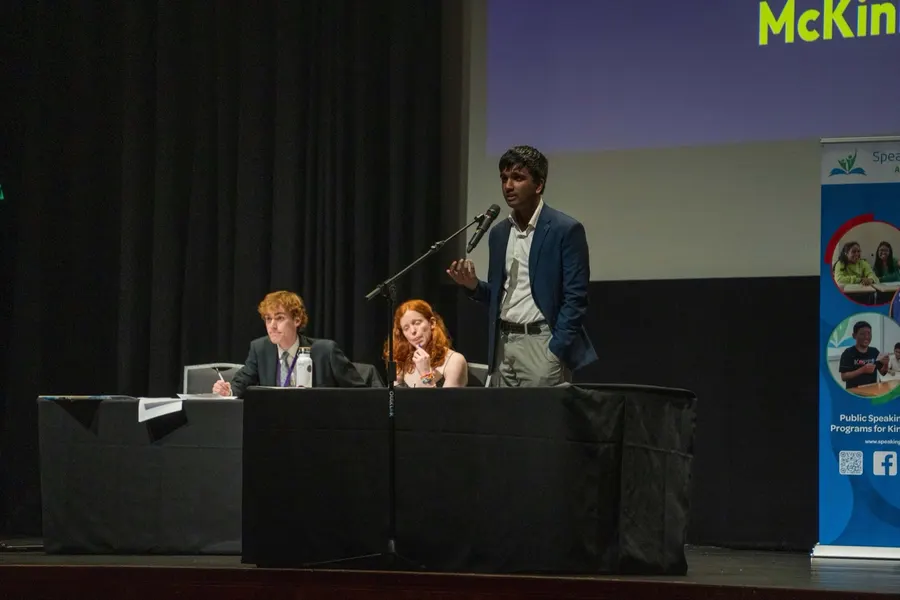
Jehiel Pather, NSW State Team
· 7 min read
The short answer
The National Schools Debating Championships are the highest level of school debating in Australia. Each state and territory sends one team, selected and trained by its debating union or association, and the teams debate seven preliminary rounds and three finals rounds. The championships have run every year since 1971 and move between states. At the end, five students who performed strongly are chosen as the Australian Schools Debating Team for the World Schools Debating Championships.
Parents usually first hear about the national championships when their child starts talking about state team trials. The two are linked: the state team exists to compete at nationals, and nationals is where the Australian schools team is picked. The details below come from the Australian Debating Federation and the state debating bodies. I debated for NSW and will coach the NSW team in 2027, so I've also added what the process looks like from the inside.
Who runs the championships
The Australian Debating Federation (ADF) is the national body for school debating, a non-profit run by volunteers. It supports a debating body in each state and territory, and those bodies run the main school competitions in their area. The ADF describes the National Schools Debating Championships as the highest level of schools debating in Australia, and says it oversees some aspects of the event.
Each state and territory's ADF affiliate selects and trains its own team:
| State or territory | Body that selects the team |
|---|---|
| New South Wales | NSW Debating Union |
| Victoria | Debaters Association of Victoria |
| Queensland | Queensland Debating Union |
| Western Australia | Western Australian Debating League |
| South Australia | South Australian Debating Association |
| Tasmania | Tasmanian Debating Union |
| ACT | ACT Debating Union |
| Northern Territory | Northern Territory Debating Union |
How the championships work
One team comes from each state and territory. According to the ADF, the teams debate seven preliminary rounds, followed by three finals rounds that decide the national champion. The event has run every year since 1971 and moves between the states and territories. For the 2024 event in Adelaide, the ADF noted that the local affiliate invites schools to host debates where they are able to.
A state team is small. Western Australia's Department of Education, writing about the 2026 championships in Brisbane, described the state's final four being chosen from an extended squad that trained together on Sundays, after a full day of impromptu trials.
Recent hosts and champions, from the ADF's history page:
| Year | Host | Champion |
|---|---|---|
| 2026 | Brisbane | Queensland |
| 2025 | Sydney | New South Wales |
| 2024 | Adelaide | Victoria |
| 2023 | Melbourne | South Australia |
| 2022 | Canberra | Queensland |
The results are close at the top. The NSW Debating Union records that NSW lost the 2026 grand final to Queensland on a 5:4 split, after winning in 2025 and finishing runner-up in 2024. By the Union's count, NSW has won the championship 22 times.
How students get there
Every state picks its team differently, but the usual route is trials followed by a training squad. In NSW, the NSW Debating Union runs trials early in the year for students in Years 10 to 12, and encourages keen Year 9s to trial too. Students speak in a debate in front of the state coaches and selectors, then sit a general knowledge quiz, and a squad is chosen to train before the final team is named. We've written the whole process up in how the NSW state debating team is selected.
Most students who reach trials have years of school debating behind them. In NSW public schools that often means the Premier's Debating Challenge, whose one-hour preparation debates are good practice for the impromptu debating students meet at trials.
How the Australian Schools Debating Team is chosen
The national championships double as selection for the Australian team. The ADF says the Australian Schools Debating Team is selected at the end of each National Schools Debating Championships, that it consists of five students who performed strongly there, and that members typically come from several different states and territories. Debating at the championships is a requirement: a student who wasn't in a state team can't be picked.
The team then competes at the World Schools Debating Championships, founded in 1988 by Chris Erskine SC, a former ADF president, and now drawing teams from over 60 countries. One coach and two adjudicators go with the team. The ADF notes that the Commonwealth Department of Education funds team members, so every selected student can attend whatever their family background or school. Australia reached the grand final in Panama in 2025.
The World Schools championship has its own format. Our guide to the World Schools debating format explains it, and how debates are marked covers what adjudicators reward.
Two of our coaches have been through it
This is the part of school debating our team knows best. Maya Garg captained NSW in 2025 and was named in that year's Australian team, which reached the World Schools grand final; she finished as the tournament's 9th best speaker. Michael Kwak captained NSW in 2024 and debated for Australia the same year. I was in the NSW state team myself and have been appointed NSW State Team Coach for 2027. You can read Maya's story or every coach's record on the results page.
Not to be confused with university championships
You may see coaches, including ours, list results from “national” or “Australasian” championships. Those are usually university competitions. The Australasian Intervarsity Debating Association governs the university championships, including the Australian Intervarsity Debating Championships (known as Easters) and the Australasian Intervarsity Debating Championships (Australs). Easters is sometimes reported as the national debating championships: the ANU headlined its 2023 win that way. These are separate from the National Schools Debating Championships, which are only for school students in state teams. We explain the university side in our guide to Australs.
Where coaching fits
No coach can promise a student a place in a state team, let alone the Australian one. What coaching can do is give a student lots of speeches with specific feedback, practice at impromptu preparation, and coaches who know what selectors are looking at. Our online classes have six or fewer students and cost $50 per student per hour, so $100 for each two-hour class; private coaching is $150 per hour. You can meet the team on the coaches page.
Common questions
- How does a student get to the National Schools Debating Championships?
- By being selected for their state or territory team. Each state's debating body runs its own selection, usually through trials. In NSW, the NSW Debating Union runs trials open to students in Years 10 to 12, and keen Year 9s are encouraged to trial.
- How is the Australian Schools Debating Team chosen?
- According to the Australian Debating Federation, the team is selected at the end of each National Schools Debating Championships and is made up of five students who performed strongly there. Debating at the championships is a requirement for selection.
- Where are the National Schools Debating Championships held?
- They rotate between the states and territories. Recent hosts include Adelaide in 2024, Sydney in 2025 and Brisbane in 2026.
- Who pays for the Australian team to go to the World Schools championship?
- The Australian Debating Federation says team members are funded with the support of the Commonwealth Department of Education, so selected students can attend regardless of family background or school.
- Is this the same as the university national championships?
- No. The National Schools Debating Championships are for state school teams. University students debate in separate intervarsity championships, such as the Australian Intervarsity Debating Championships and the Australasian championship known as Australs.