What is Australs? The Australasian debating championship explained
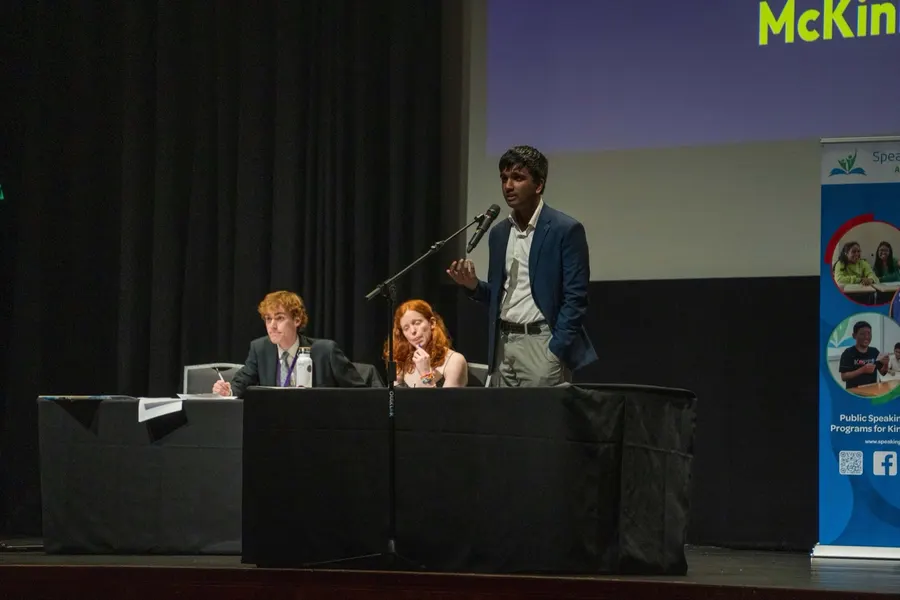
Jehiel Pather, NSW State Team
· 6 min read
The short answer
Australs is the Australasian Intervarsity Debating Championships, a university tournament governed by the Australasian Intervarsity Debating Association. University teams from Australia, New Zealand and across Asia debate in the three-on-three format that Australian school students also use, over eight preliminary rounds followed by finals. It is usually held in July and moves between host universities around the region. Because it is large and the results are published, a strong result at Australs is a credential parents can check for themselves.
When parents read our coaches' records, the word they ask about most is “Australasian”. Two of our founders, Oliver Bardsley and I, won the Australasian Debating Championship, and two of our coaches have reached its semi-finals. This guide explains what that championship is, usually just called Australs, and how it relates to the debating your child does at school.
What Australs is
Australs is the Australasian Intervarsity Debating Championships. It is a university competition: teams represent their university, not a state or a country. It is governed by the Australasian Intervarsity Debating Association (AIDA), which coordinates university debating across the region and runs three championships:
- the Australasian Intervarsity Debating Championships (Australs)
- the Australian Intervarsity Debating Championships (Easters)
- the Australasian Women's Intervarsity Debating Championships
AIDA also runs the bidding process for universities that want to host future championships, which is why Australs moves around the region from year to year. Past hosts on AIDA's list of tournaments include the University of Otago (2014), Solbridge University in South Korea (2015), the University of Western Australia (2016) and the University of Queensland (2017).
The 2026 championship was hosted by the University of Wollongong from 1 to 8 July. According to UOW TV, it was the first Australs held in person in Australia since 2017, after recent championships in Jakarta (2024) and Guangzhou (2025), and organisers expected representatives from eleven countries.
How the tournament runs
The Monash Association of Debaters describes Australs as the largest three-on-three tournament of the year in the region, bringing together teams from Southern and Eastern Asia, Australia and New Zealand. Three-on-three is the format most Australian school students already know: three speakers for each side, taking turns. If your child is new to it, our lesson on how a debate works walks through each speaker's job.
Teams debate eight preliminary rounds, then the best teams go through to finals. The published tab for Australs 2022 shows the structure: eight preliminary rounds, then separate finals series for the Open category and for ESL and EFL teams (debaters speaking English as a second or foreign language), each with its own grand final. A university in South Korea reported that its team reached the EFL grand final in 2026, in a field of more than 50 teams.
Alongside the team results, every speech gets an individual score, and speakers are ranked across the tournament on a published speaker tab. That makes the results easy to check.
Australs and Easters compared
Parents sometimes see both on a coach's record. Both are AIDA championships for university students, but they serve different purposes.
| Australs | Easters | |
|---|---|---|
| Full name | Australasian Intervarsity Debating Championships | Australian Intervarsity Debating Championships |
| When | July | Around the Easter holidays |
| Who | Universities from Australia, New Zealand and across Asia | Teams must include at least two novices |
| Format | Three speakers a side | Three speakers a side, 8-minute speeches |
The Easters details are from the Monash Association of Debaters, which describes Easters as aimed at newer debaters and Australs as the more competitive of the two. A novice, for Easters, is someone who has debated at fewer than two Easters and never at Australs or the world university championship. Easters is sometimes reported as the national championship; the ANU called its 2023 Easters win a win at the “National Debating Championships”.
Neither should be confused with the National Schools Debating Championships, which are for high-school students in state teams.
Why it matters as a coaching credential
A few things make an Australs result a useful signal when you are choosing a coach.
It is checkable. Tabs for Australs are published online, so you don't have to take a coach's word for a result. We think parents should look things up, and we say the same in our guide to choosing debating coaching.
It is demanding. Australs draws university teams from across the region, and doing well there means winning debate after debate over eight preliminary rounds and then the finals, in front of different adjudicators each time.
It is the right format. Because Australs uses three speakers a side, the skills a coach sharpened there are the ones your child needs at school: building a case as a team, rebuttal, and explaining why your side's arguments matter more. Our guide to how debates are marked covers what adjudicators reward.
A championship result doesn't make someone a good teacher on its own, so it's still worth asking how a coach works with students your child's age.
Our coaches' Australs and intervarsity results
These are the results as listed on our coaches page, and every coach's full record is on our results page.
- Jehiel Pather: Australasian Debating Championship champion
- Oliver Bardsley: Australasian Debating Championship champion
- Maya Garg: Australasian Debating Championship semi-finalist, 2026
- Jack Glass: Australasian Debating Championship semi-finalist, 2025
Several of us have also been involved in Easters, the Australian Intervarsity Debating Championship. Oliver was its best speaker and Catherine Chen reached the semi-finals. I was a Deputy Chief Adjudicator in 2026, and Jade Di Girolamo is Chief Adjudicator for 2027. Adjudication roles matter for coaching too: the people in them set the motions and run the judging, so they know in detail how debates are decided.
How this connects to our classes
Your child won't be debating at Australs for a few years yet, but they are learning the same format now. Our online classes have six or fewer students, with a skill workshop and a live debate each week. They cost $50 per student per hour, so $100 for each two-hour class, and private coaching is $150 per hour.
Common questions
- Can high-school students compete at Australs?
- No. Australs is an intervarsity championship, so teams represent universities. School students debate in school, state and national schools competitions, and some go on to Australs once they're at university.
- What is the difference between Australs and Easters?
- Both are governed by the Australasian Intervarsity Debating Association. Easters is the Australian Intervarsity Debating Championships, held around Easter, and teams must include novices. Australs is the Australasian championship, which brings in universities from across Asia and the Pacific and is the more competitive of the two.
- Is Australs the same format as school debating?
- It's the same family. Australs uses three speakers on each side, like most Australian school competitions, so the skills carry over directly in both directions.
- Why does an Australs result matter for a coach?
- Australs results and speaker rankings are published, and the field includes strong university teams from across the region. A coach who has won or gone deep at Australs has been tested against that field, and you can check the result yourself.