What is World Schools debating format?
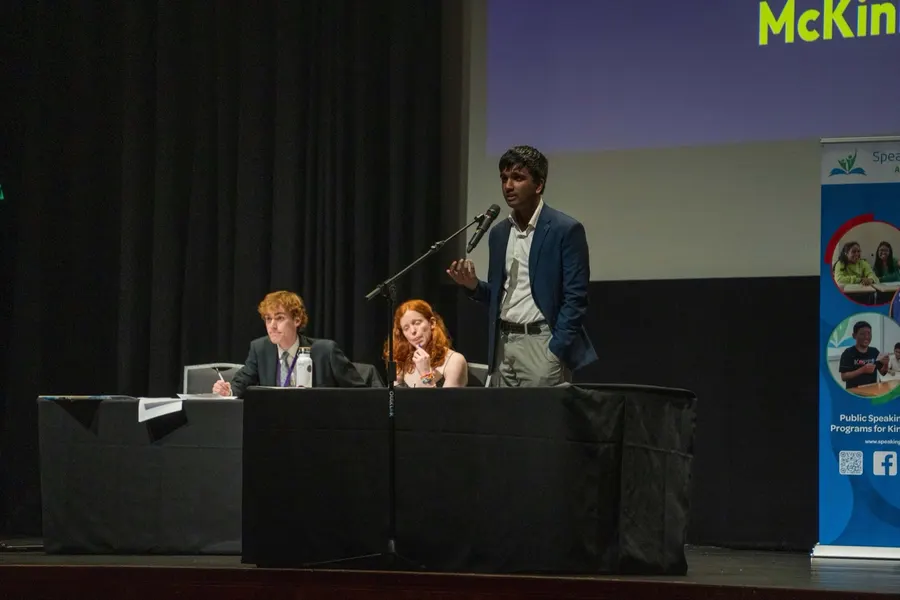
Jehiel Pather, NSW State Team
· 7 min read
The short answer
World Schools is the format used at the World Schools Debating Championships. Two teams of three debate a motion: the proposition supports it and the opposition opposes it. Each speaker gives an 8-minute speech, then the first or second speaker on each side gives a 4-minute reply speech, opposition first. During the substantive speeches, between the first and seventh minute, the other team can offer points of information of up to 15 seconds. Some motions are released weeks in advance and others are impromptu, with one hour to prepare and no internet or devices.
World Schools is the format of the World Schools Debating Championships (WSDC), where countries send national teams of high school students. Students in Australia usually meet it once they start debating at a representative level. If your child already knows the basic three-on-three shape from how a school debate works, World Schools will feel familiar. This post covers what is different. The details below come from the WSDC Tournament Committee and Debate Rules (the version updated in August 2026).
The basic shape of a World Schools debate
There are two teams. The proposition supports the motion and the opposition opposes it, which is the same job the affirmative and negative do in an Australian school debate under different names. Each team has three speakers, each speaker speaks once, and they alternate sides: first proposition, first opposition, and so on down to the third speakers. Then come the two reply speeches. A national team can have three to five members, so a squad can rotate speakers between rounds.
| Speech | Length | Points of information? |
|---|---|---|
| First, second and third speakers (each side) | 8 minutes | Yes, between the first and seventh minute |
| Opposition reply (first or second speaker) | 4 minutes | No |
| Proposition reply (first or second speaker) | 4 minutes | No |
What each speaker does
The roles track the Australian ones closely, so I won't repeat the whole of that lesson. The first proposition defines the motion, sets out the issues, outlines the team's case and announces the split between speakers. The first opposition can challenge the definition if it's unreasonable, responds to the proposition and sets out their own case. The second speakers deal with any definitional dispute, respond to the other team and continue their own case.
The third speaker is where World Schools differs most in practice. The rules say the third speaker's primary role is to respond to what has gone before, and that they may present a small part of the case only if the first speaker announced it. Because the reply speech exists, the third speaker can spend almost the whole eight minutes on detailed rebuttal and leave the big-picture summary to the reply.
What is a reply speech?
After the six main speeches, each team gets one more, four minutes long. It must be given by the first or second speaker, never the third. The order flips, so the opposition reply comes first and the proposition gets the last word. The rules describe the reply as a sum up of the debate from the team's point of view: a response to the other side's overall case and a summary of their own. No new part of the case is allowed, though a reply speaker can use a new example to illustrate an argument already in the debate.
Good replies are about the shape of the debate, not a list of points. We teach students to pick the two or three questions the debate turned on and explain why their team won each one. A reply that sounds like a fourth rebuttal speech usually wastes the format.
How points of information work
A point of information (POI) is a short question or point offered by the other team during a speech. An opposing speaker stands and offers it, and the person speaking decides whether to take it. Under the WSDC rules:
- POIs can be offered between the first and seventh minutes of a substantive speech, so the first and last minute are protected.
- A POI should be no longer than 15 seconds.
- No POIs are allowed during reply speeches.
- The speaker can refuse any POI, or take it at the end of their next sentence, but as a general rule should accept at least two. Taking many more risks losing control of the speech.
- Speakers should keep offering POIs before and after their own speech, without offering so often that it becomes barracking.
POIs count for both sides. The way a speaker answers one is part of their own mark, and offering good ones is part of the mark for the speaker who offers them.
Prepared and impromptu motions
World Schools mixes two kinds of debate. Prepared motions are released well before the championship, so teams can research them in depth. At WSDC, preliminary rounds 1 and 2 are prepared debates, and the motion for the grand final is announced at the same time as the preliminary motions. Rounds 3 to 8 are impromptu, and so are the knockout rounds up to the semi-finals.
For an impromptu debate, each team gets one hour from the moment the motion is read out. Only the team's own members can help prepare. They can't take phones, computers or any device that can reach outside information into the prep room, and the only reference material allowed is a dictionary, a bilingual dictionary and a single-volume encyclopaedia or almanac. If the wording of a motion is unclear, a team can ask for clarification in the first 15 minutes only.
This is why general knowledge matters so much at representative level. An hour, three students and a blank page is a test of what they already know about economics, international relations and social policy, and of how quickly they can turn it into arguments. Our lesson on structuring an argument is the method we teach for using that hour well.
How World Schools debates are marked
Each substantive speech is marked out of 100: 40 for style, 40 for content and 20 for strategy. Reply speeches are marked out of 50 in the same proportions. Content is the argument itself, judged apart from how it's delivered, and a weak argument is marked down even if the other team never points out the weakness. Style is the way the speaker speaks. Strategy covers whether the speaker understands the issues, how they prioritise them, and the structure and timing of their speech. Judges must mark within a set range, 60 to 80 for a substantive speech. We go through Australian marking, and how it compares, in how debates are marked.
How it differs from a typical Australian school debate
Australian school competitions are run by different bodies in each state, and the rules vary, so it's worth checking your child's competition. As one example, the NSW Premier's Debating Challenge uses one-hour preparation for every debate, three speakers plus a fourth team member acting as adviser, and speaking times that grow with age: 4 minutes in Years 5 and 6, 6 minutes in Years 7 and 8, and 8 minutes from Year 9 up. Its published rules don't include reply speeches or points of information.
| World Schools (WSDC rules) | Premier's Debating Challenge (NSW) | |
|---|---|---|
| Sides | Proposition and opposition | Affirmative and negative |
| Main speeches | 8 minutes | 4 to 8 minutes depending on year level |
| Reply speeches | Yes, 4 minutes, opposition first | Not in the published rules |
| Points of information | Yes | Not in the published rules |
| Preparation | Some prepared motions, some one-hour impromptu | One hour for every debate |
| Marking categories | Style, content, strategy (40/40/20) | Not published on the competition page |
Two further differences catch students out. The first is the burden of proof. The WSDC rules say the proposition only has to show its case is true as a general principle or in the majority of cases, while the opposition must raise more than a reasonable doubt, and the opposition may choose to attack the proposition's case without running a positive case of its own. By contrast, the Australian Debating Federation's Australia-Asia Debating Guide says that in most debates it isn't enough for the negative to rely entirely on rebuttal. The second is that WSDC rules expressly bar place-setting and time-setting, where a team narrows a general motion to one country or one period.
Who debates World Schools at the top level
Debaters at WSDC must be at least 14 on the first day of debates and under 20 on the day of the grand final, and must have been full-time secondary students in the academic year before. In Australia, the national team is chosen by the Australian Debating Federation from students who compete at the National Schools Debating Championships, which in turn draws on the state teams (we explain the NSW side of that in how the NSW state team is selected). One of our coaches, Maya Garg, reached the WSDC grand final in 2025 and was ninth best speaker at the championship. Her story is in From NSW captain to a World Schools grand final.
Practising World Schools skills
Students who want to debate at representative level need practice with the parts that ordinary school debating may not give them: eight full minutes, offering and answering POIs, and replies. In our online classes of six or fewer, every class includes a live debate with feedback, and private coaching can focus on whichever of these a student needs most. Group classes are $50 per student per hour, so $100 for each two-hour class, and private coaching is $150 per hour. Class times are on the programs page, and you can read about the coaches on the coaches page.
Common questions
- How long are speeches in World Schools debating?
- Under the World Schools Debating Championships rules, substantive speeches are 8 minutes and reply speeches are 4 minutes.
- Who gives the reply speech in World Schools debating?
- The first or second speaker of each team, never the third. The opposition reply comes first and the proposition reply comes last, and neither may introduce a new part of the team's case.
- How many points of information should a speaker take?
- The WSDC rules say that, as a general rule, a speaker should accept at least two points of information in their speech, and that accepting many more risks losing control of the speech. Points can be offered between the first and seventh minutes and should last no longer than 15 seconds.
- How much preparation time do teams get for an impromptu World Schools debate?
- One hour from when the motion is read out. Only team members can help, and teams can't bring in phones, computers or printed research, apart from dictionaries and a single-volume encyclopaedia or almanac.
- Is World Schools the same as the format used in Australian schools?
- They share the same shape: two teams of three. World Schools adds compulsory reply speeches and points of information, uses 8-minute speeches throughout, and marks speeches for style, content and strategy rather than matter, manner and method. Some Australian school competitions, such as the NSW Premier's Debating Challenge, use shorter speeches for younger students and don't include replies or points of information in their published rules.