Debating coaching in Brisbane: a guide for parents
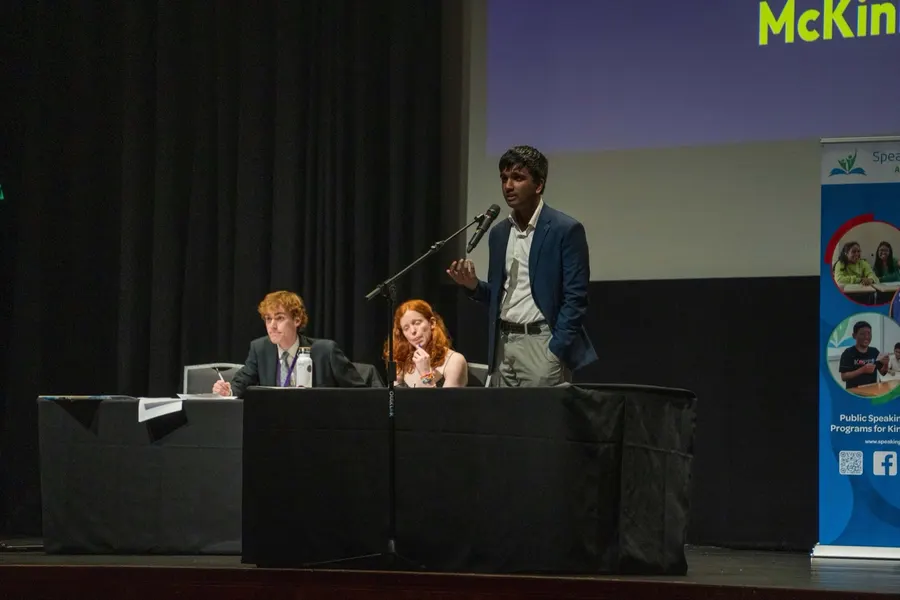
Jehiel Pather, NSW State Team
· 7 min read
The short answer
Most Brisbane students debate in the Queensland Debating Union (QDU) competitions, which run for Years 5 to 12 in Brisbane and Toowoomba. Secondary teams debate four rounds in Terms 1 and 2, usually one long-preparation topic and three short-preparation topics released an hour before the debate, and eligible teams go on to finals in Term 3. The QDU also selects the Queensland team for the National Schools Debating Championships. DebateBetter teaches online in groups of six or fewer. Queensland has no daylight saving, so from October to early April our Sydney-time classes start an hour earlier in Brisbane.
Queensland families who get in touch usually want to know two things: how our classes would fit around what their child does at school, and what time they'd actually start in Brisbane. This guide covers both, along with how the Queensland state team is chosen and what to look for in a coach. The competition details come from the Queensland Debating Union's own website, rules and 2026 coordinator's guide. They change from year to year, so check with the QDU or your school before planning around anything here.
How school debating works in Queensland
The QDU is a registered charity and the state's peak debating body. It runs annual competitions for Years 5 to 12 in Brisbane and Toowoomba and works with regional affiliates elsewhere in Queensland. Its coordinators page lists four competitions:
| Competition | Years | Rounds |
|---|---|---|
| Brisbane Secondary | 8 to 12 | 4 rounds in Terms 1 and 2, knockout finals in Term 3 for eligible teams |
| Brisbane Year 7 | 7 | 4 rounds in Terms 1 and 2 |
| Brisbane Primary | 5 and 6 | 4 rounds in Terms 3 and 4 |
| Toowoomba | 7 to 12 | 4 rounds in Terms 1 and 2, knockout finals in Term 3 for eligible teams |
The Brisbane competitions cover Brisbane, Ipswich, Redland Bay, Logan, Moreton Bay and surrounding areas, and debates are hosted at schools. Teams have four or five members, three of whom speak in each debate. Each year level has its own grade, and there is also a Senior A grade, which the QDU Rules describe as the highest grade, open to any student in Year 12 or below. In the 2026 QDU calendar, the Brisbane grand final night was for Senior A only, on a short-preparation topic.
Long preparation and short preparation
The QDU's 2026 coordinator's guide sets out the style of each round. Round one is a long preparation debate for every year level, with the topic known well in advance. From Year 8 up, the other three rounds are all short preparation. Year 7 alternates, with long preparation in rounds one and three.
In a short preparation debate the topic is released 60 minutes before the debate starts. Up to four team members go into the preparation room, and the rules on what they can take in are tight: writing materials, blank paper, a watch that can't communicate, water and one unannotated dictionary. No phones, laptops or smartwatches, and no contact with coaches, parents or other debaters until the debate begins. Compared with some other states, where printed research is allowed into the room, Queensland students go in with only what they know.
Speech length grows steadily through the year levels. These are the final-bell times from Rule 15 of the QDU Rules:
| Year level | Speech length |
|---|---|
| Years 5, 6 and 7 | 4 minutes |
| Year 8 | 5 minutes |
| Year 9 | 6 minutes |
| Year 10 | 7 minutes |
| Years 11, 12 and Senior A | 8 minutes |
| Reply speeches | 4 minutes |
Put those together and a Year 10 student is giving seven-minute speeches on topics they first saw an hour earlier, with nothing in the room but a pen and some paper. The skills that carry a student through that hour are a reliable way of finding arguments, a feel for what the other side will say, and enough general knowledge to give real examples. Our lessons on structuring an argument and models and counter-models are written with that kind of preparation in mind.
One rule is worth knowing before you choose a coach. Rule 16.1 says students must prepare their team's speeches, and that coaches, parents or others must not write, prepare or dictate them. Good coaching teaches a student how to build a case, then lets them do it.
The QDU also runs QDU Academy, free online sessions before each round presented by experienced coaches and adjudicators, with recordings usually posted to its YouTube channel. They're a good resource for any Queensland student in the competition.
How the Queensland state team is chosen
As an affiliate of the Australian Debating Federation, the QDU selects the Queensland Schools State Team for the annual National Schools Debating Championship, the tournament between the states and territories that we cover in our guide to the national schools championship. Brisbane hosted the 2026 championship in May, according to the QDU calendar.
When we checked, the QDU's website didn't publish current trial dates or eligibility for the state team, so we won't guess at them here. If your child is interested, ask your school's debating coordinator or email the QDU at admin@qdu.org.au. Our guide to NSW state team selection describes how one state runs trials, and most of the preparation advice in it applies anywhere: get comfortable with eight-minute speeches, practise impromptu preparation to a clock, be strong in more than one speaking position, and read the news properly.
What to look for in a coach
Ask which teams a coach has debated for and what they won, because those results are published and you can check them. Ask how many students are in a class and how many speeches each one gives per session, since students improve by speaking and getting feedback, and in a big class some barely speak. Ask what feedback looks like after a speech. Useful feedback points to a specific moment and gives the student one concrete thing to change next time.
For a Queensland student, ask how much of each class is spent preparing to a clock on unseen topics, since three of the four rounds are short preparation from Year 8 onwards. Our guide to what coaching costs and our comparison of online and in-person coaching may help if you're weighing options.
Online classes on Brisbane time
Our class times are set in Sydney time. Queensland doesn't use daylight saving, so the gap with Sydney changes during the year. From the first Sunday in October to the first Sunday in April, while New South Wales is on daylight saving, Brisbane is an hour behind Sydney. For the rest of the year the two cities show the same time.
| Sydney time | Brisbane, October to early April | Brisbane, April to October |
|---|---|---|
| 7 to 9pm | 6 to 8pm | 7 to 9pm |
| 10am to 12pm | 9 to 11am | 10am to 12pm |
Term 4 group classes run on Mondays, Wednesdays and Fridays from 7 to 9pm, and on Sundays from 10am to 12pm or 7 to 9pm, Sydney time, so at the moment each one starts an hour earlier in Brisbane. We always confirm your child's class in your local time. QDU rounds are mostly on Wednesday nights, so check your child's debate night before picking a class. Private coaching can be booked at whatever time suits.
Where DebateBetter fits
DebateBetter is an online academy with no venue in Brisbane or anywhere else. Classes have six or fewer students, grouped by year level and experience, so everyone gives a speech and gets feedback every session. Our coaches include former NSW state team captains, an Auckland representative debater, and Jack Glass, joint best speaker at the 2026 Australian British Parliamentary Debating Championship. You can read their records on the coaches page and the results page.
Group classes are $50 per student per hour, and each class is two hours, so $100 a class, paid class by class or for the rest of the term at $90 a class. Private coaching is $150 per hour. Class times and enrolment are on the programs page, or get in touch if you'd like to talk it through first.
Common questions
- What debating competitions are there for Brisbane school students?
- The Queensland Debating Union runs a Brisbane Secondary Competition for Years 8 to 12, a Brisbane Year 7 Competition, a Brisbane Primary Competition for Years 5 and 6, and a Toowoomba Competition for Years 7 to 12. Schools enter teams, so the first step is your child's school debating coordinator.
- What is a short preparation debate in Queensland?
- The topic is released 60 minutes before the debate. Up to four team members prepare in a room with writing materials, blank paper, a non-electronic watch and one unannotated dictionary, and no phones or laptops. Coaches and parents can't communicate with the team during that hour.
- How long are debating speeches in Queensland?
- Under the QDU Rules, speeches are 4 minutes in Years 5 to 7, 5 minutes in Year 8, 6 minutes in Year 9, 7 minutes in Year 10, and 8 minutes in Years 11 and 12 and Senior A. Reply speeches are 4 minutes.
- Who selects the Queensland state debating team?
- The Queensland Debating Union selects the Queensland Schools State Team for the National Schools Debating Championship. Trial dates and eligibility aren't currently published on its website, so ask the QDU or your school's debating coordinator.
- What time are DebateBetter's classes in Brisbane?
- Our class times are set in Sydney time. Queensland doesn't use daylight saving, so from October to early April Brisbane is an hour behind Sydney and a 7pm class starts at 6pm. For the rest of the year the times are the same.
- Do you have a venue in Brisbane?
- No. DebateBetter has no venue in any city. Every class runs online over Zoom, so Brisbane students join from home.