Online vs in-person debating coaching: which is better for my child?
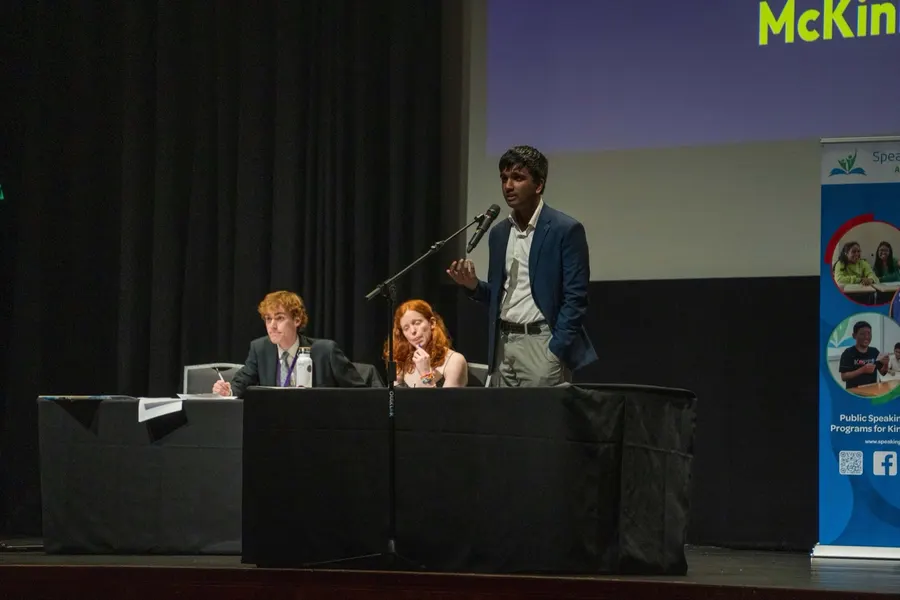
Jehiel Pather, NSW State Team
· 7 min read
The short answer
Online debating coaching works well for most students, because a debate is one person speaking at a time to an audience, which video handles easily, and some school competitions already run debates online. It removes travel and widens the choice of coaches. In-person suits younger children who find it hard to focus on a screen, and students who need the energy of a room. Whichever you choose, the class size and the amount of speaking and feedback each student gets matter more than the format.
We only teach online, so you might expect us to say online is better. It isn't, for every child. Some students do their best work in a room with other people, and if that's your child, an in-person class is the right choice. What follows is how we'd think about the decision if we didn't run either kind.
Why debating suits video
A debate is unusually well matched to a video call. In a 3-on-3 school debate (the format most Australian schools use, explained in how a debate works), only one person speaks at a time, for a fixed number of minutes, while everyone else listens and takes notes. There's no equipment to share and no physical skill to correct. What a coach needs to see and hear (the structure of the speech, how the student responds to the other side, how clearly they speak) all comes through on screen.
Competitions have already moved some debating online. The NSW Department of Education's rules for the Premier's Debating Challenge say debates can be held in person or online to suit the schools involved. In Victoria, the Debaters Association of Victoria runs an online version of its schools competition on Zoom alongside the in-person one, and its Junior Secondary Program for Years 7 and 8 is offered online as well as face to face. A student who has practised online is ready for those debates.
What online does well
The first advantage is practical. A weeknight class across town can mean an hour in the car for a two-hour lesson. Online, your child finishes dinner and logs on. Families outside the capital cities, or in towns with no debating coaching at all, get the same options as everyone else.
The second is who can teach. Many of the strongest debating coaches are university students who are still competing. They often can't get to a suburban classroom at 5pm, but they can teach from wherever they are. Online, a family in Perth or regional Queensland can have a coach who represented another state.
The third is that classes can be grouped more carefully. A local in-person class has to take the students who live nearby. An online class can put together students of a similar age and experience from all over the country, so a beginner isn't thrown in with experienced debaters, and a strong debater isn't held back.
Where in person is better
Some children find a screen hard. Younger students especially can drift when they're not in the same room as the coach, and a quiet child may find it easier to disappear in an online class than in a room where the coach can catch their eye.
There's also the social side. Debating friendships often form in the corridor before a debate or in the car on the way home. Online classes can build a good group, but the casual moments are fewer.
And some households make online harder: a shared computer, unreliable internet, or nowhere quiet to sit for two hours. These are real reasons to choose a room.
What to look for in an online class
A good online class and a poor one can look the same on a website. The differences show up in the first session.
- Size. Ask how many students are in the class. A class of six can run a full three-on-three debate with everyone speaking. In a class of fifteen, most students spend most of the session watching.
- Speaking time. Ask how many speeches each student gives per session. The answer should be at least one.
- Feedback. After a trial, ask your child what the coach told them to change. If they can name something specific, the feedback is working.
- Structure. A good online class has a plan: a skill taught, then practised in a debate. A lecture over video is harder to follow than one in a room.
- Safety. Ask whether coaches hold a Working With Children Check and how the provider handles recordings, since any recording of a group class shows other children.
Comparing the two
| Online | In person | |
|---|---|---|
| Travel | None | Depends where the class is |
| Choice of coach | Anyone, anywhere | Whoever can get to the venue |
| Grouping by age and experience | Easier, with students from many places | Limited to students nearby |
| Focus for younger children | Harder for some | Usually easier |
| Social contact | Within the class | More informal time together |
| What matters most | Small classes, a speech every session and specific feedback | |
A simple way to decide
If your child already enjoys video calls, can sit through a lesson at home without being pulled away, and you'd rather not do the drive, try online. If they've struggled with online school before, or they light up around other people in a way a screen doesn't catch, look for a room. Either way, book one class before committing to a term. You'll know after the first session.
If speaking in front of others is the hard part, the format matters less than the approach, and our guide to helping kids with public speaking nerves covers what helps. For prices across both formats, see how much debating coaching costs.
How our classes work
DebateBetter classes run online over Zoom, in groups of six or fewer students, grouped by age and experience. Each two-hour class teaches a skill and then puts it to work in a live debate with feedback from the coach. Group classes are $50 an hour per student ($100 for a two-hour class, paid class by class or for the rest of the term at $90 a class), and private coaching is $150 an hour. Every coach holds a verified Working With Children Check, and we don't share class recordings. You can read about the coaches on the coaches page and see class times on the programs page.
Common questions
- Is online debating coaching as effective as in person?
- For most students, yes, provided the class is small and every student speaks and gets feedback each session. A large online class where students mostly listen is less useful than a small one in either format.
- Do debating competitions run online?
- Some do. The NSW Premier's Debating Challenge allows debates to be held in person or online, and the Debaters Association of Victoria runs an online version of its schools competition on Zoom.
- What age is too young for online debating classes?
- There's no fixed age. It depends on how well your child concentrates on a screen and joins in a conversation by video. A trial class is the easiest way to find out.
- What does my child need for an online debating class?
- A computer or tablet with a camera and microphone, a reasonable internet connection, and a quiet space to join from. Headphones help in a busy house.
- Are DebateBetter classes online or in person?
- Online only, over Zoom, in groups of six or fewer students. Students join from across Australia and overseas.