What age should kids start debating?
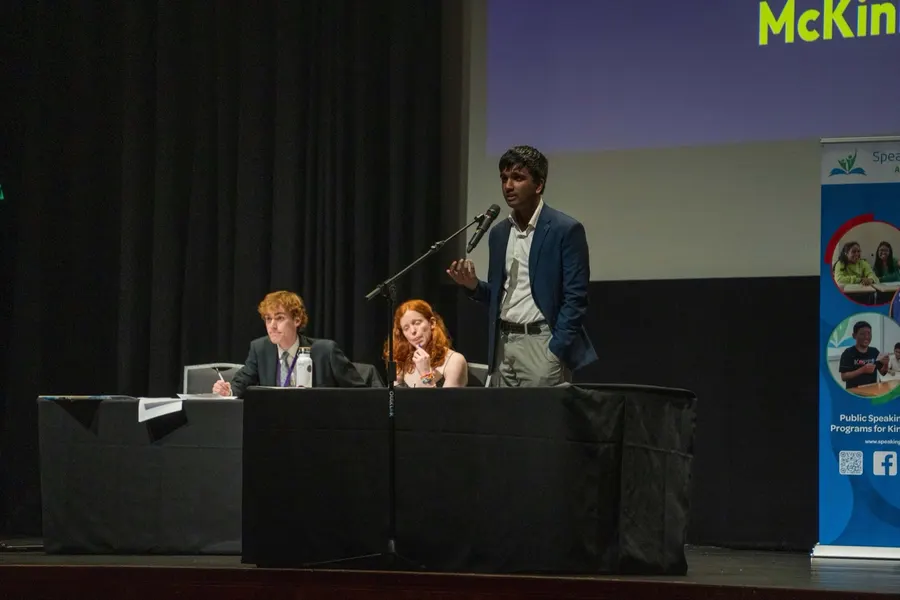
Jehiel Pather, NSW State Team
· 7 min read
The short answer
Children can start competitive debating in upper primary school. In NSW, the Premier's Debating Challenge for government schools starts with a Years 5 and 6 division, with four-minute speeches, and moves up to eight-minute speeches by Years 9 and 10. In Victoria, the Debaters Association runs an introductory program for Years 7 and 8 and a schools competition for Years 9 to 12. There's no single right age: a child is ready when they can follow an argument, speak for a few minutes on a topic, and want to have a go.
There's no age at which a child becomes ready to debate. Some Year 5s take to it immediately, and some students first try it in Year 10 and go further than anyone expected. The useful question is what debating looks like at your child's age, because the competitions are designed with that in mind. The details below come from the competition organisers themselves, so you can check them for your own state.
How school competitions are divided
School debating in Australia is organised by year level, and the demands grow as students move up. Two of the largest school competitions show how it works.
New South Wales
The Premier's Debating Challenge, run by the NSW Department of Education's Arts Unit for government schools, has four state-wide divisions: Years 5 and 6, Years 7 and 8, Years 9 and 10, and Years 11 and 12. Every debate in the challenge is prepared in one hour, and a team fields four members: three speakers and a team adviser. Speaking time grows with the division.
| Division | Speaking time |
|---|---|
| Years 5 and 6 | 4 minutes |
| Years 7 and 8 | 6 minutes |
| Years 9 and 10 | 8 minutes |
| Years 11 and 12 | 8 minutes |
The Arts Unit's speaking competitions page also lists Year 6 and Year 10 representative debating, so primary students already have a path beyond their own school. Independent and Catholic schools have their own competitions, and at the top end the NSW Debating Union selects the state team from Years 10 to 12 (see how the NSW team is selected).
Victoria
The Debaters Association of Victoria runs its schools competition for Years 9 to 12, in four grades. Year 9 students are introduced to it through prepared topics, and from Year 10 students debate a mix of prepared topics and secret topics announced on the night. For younger students, the DAV's Junior Secondary Program is an introduction to debating for Years 7 and 8, with training in the basic skills and three friendly debates against other schools. The DAV also lists a primary schools program.
What this tells you about age
The pattern is consistent. The youngest students get short speeches and a gentle introduction, and the expectations rise steadily. A Year 5 speaker in NSW needs to fill four minutes. By Year 9 it's eight, which is a different task: you need more material and a structure the adjudicator can follow for twice as long.
So starting early isn't a race to win at eleven. It gives a child time to get comfortable standing up and making a point before the speeches get long and the topics get hard. Starting later is fine too. A student who comes to debating in Year 9 has a sharper mind and a bigger vocabulary to work with, and can move quickly with practice.
Signs your child is ready
Age matters less than a few things you can see at home.
- They argue back. A child who pushes on your reasons for bedtime, or wants to know why a rule exists, already has the instinct debating builds on.
- They can talk about one topic for a couple of minutes without wandering off it. Ask them to convince you of something small, like a later bedtime or a different holiday, and see how long they keep going.
- They're curious about the news, or about how things work. Debate topics are about the world, so interest in it helps.
- They want to try. A reluctant child pushed into a competition often has a bad first experience. A curious one usually enjoys it, even if the first speech is wobbly.
Nerves aren't a sign a child isn't ready. Most debaters are nervous at first, and plenty of quiet children turn out to like the structure debating gives them. Our guide to public speaking nerves has practical ways to help.
Debating or public speaking first?
Some children start with public speaking, where they prepare a speech on their own topic, and move into debating later. Others go straight to debating because they like arguing with someone. Neither order is wrong. We've compared the two in debating vs public speaking.
When coaching helps
For most children, the school team is the right first step. Coaching is worth considering when your child wants to debate more often than the school season allows, wants feedback that goes beyond a win or a loss, or is preparing for something bigger, such as representative trials. Beginners can start with coaching too, as long as the class is pitched at their level rather than mixed in with experienced debaters.
At DebateBetter, classes are grouped by age and experience, with beginner and advanced classes, so a new debater starts with the basics of how a debate works and how to build an argument. Classes are online, in groups of six or fewer students, at $50 an hour per student ($100 for a two-hour class, paid class by class or for the rest of the term at $90 a class). Private coaching is $150 an hour. Tell us your child's year level and experience on the programs page and we'll suggest a class.
Common questions
- What is the youngest division in the Premier's Debating Challenge?
- Years 5 and 6. The NSW Department of Education's Arts Unit lists four divisions: Years 5 and 6, 7 and 8, 9 and 10, and 11 and 12. Speeches are four minutes in the youngest division.
- Is it too late to start debating in high school?
- No. Victoria's schools competition, for example, starts at Year 9, and the Debaters Association of Victoria runs an introductory program for Year 7 and 8 students who haven't debated in it before. Students who start in high school can catch up quickly with regular practice.
- Should a shy child start debating?
- Often, yes. Debating gives a nervous speaker a clear structure, a team to lean on and a set time to speak, which can make standing up easier than an open-ended speech. Start with low-pressure practice rather than a competition.
- When should my child start debating coaching?
- When they want more practice than the school team gives them, or more detailed feedback. Many students start coaching once they've had a season of school debating and know they enjoy it, but beginners can start coaching too.
- How do debates change as students get older?
- Speeches get longer, topics get harder, and preparation time can get shorter. In the Premier's Debating Challenge, speaking time goes from four minutes in Years 5 and 6 to eight minutes in Years 9 to 12.