Debating vs public speaking: what's the difference, and which suits my child?
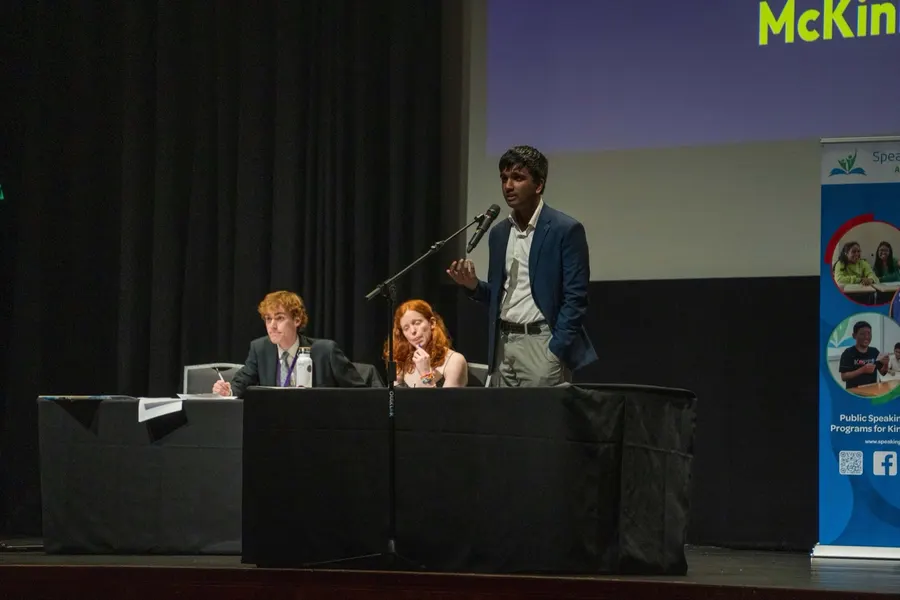
Jehiel Pather, NSW State Team
· 7 min read
The short answer
Public speaking means giving a speech you've prepared, usually alone, on a topic you've chosen or been set, and it's judged on content and delivery. Debating means arguing one side of a topic in a team against another team, rebutting what they say, and it's judged on who made the stronger case. Public speaking suits children who like to polish an idea and perform it; debating suits children who like to argue, think on their feet and work in a team. Many students do both, and each helps the other.
Parents often use the two words to mean the same thing, and schools sometimes run them through the same teacher, but they're different activities. A child who dreads one may love the other. Here's how they differ, what each teaches, and how to choose.
What public speaking is
In a public speaking competition, a student gives a speech they've written and rehearsed, on their own. The topic might be chosen from a list or left open. They're judged on what they say and how they say it: whether the speech has a clear idea, whether it holds the audience, and how well it's delivered.
Many competitions add a short impromptu speech, which tests whether the student can think quickly as well as rehearse well. But the heart of public speaking is a single voice, a single idea, and as much preparation as the student wants to put in.
What debating is
In a debate, two teams argue opposite sides of a topic, and the side is usually assigned, not chosen. In most Australian school competitions each team has three speakers who take turns, and every speaker after the first has to respond to what the other team has said. (Our lesson on how a debate works walks through each speaker's role.)
Adjudicators decide which team made the stronger case, so a debater can't simply give a good speech. They have to engage with the other side, which is why rebuttal is so central. Preparation time is often short. Every debate in the NSW Premier's Debating Challenge, for example, is prepared in one hour, and teams find out the topic and their side only when that hour starts.
The differences side by side
| Public speaking | Debating | |
|---|---|---|
| Who speaks | One student, alone | A team of three, against another team |
| The topic | Often chosen by the student from a list | Set, with the side usually assigned |
| Preparation | Weeks, for the prepared speech | Often an hour or less, sometimes weeks for prepared topics |
| Responding to others | Not usually | Central to every speech after the first |
| How it's judged | The quality of the speech itself | Which team made the stronger case |
The skills each builds
Public speaking is very good at delivery: voice, pace, pauses, eye contact, and how to hold a room for several minutes. It also teaches students to shape an idea into a speech with a clear beginning and end, and to write for the ear rather than the page.
Debating is very good at thinking. A debater learns to find arguments for a side they may not agree with, to spot the weak link in someone else's reasoning, and to explain why their point matters more. They learn to work under time pressure and as part of a team. Delivery matters in debating too, but a beautifully delivered speech that ignores the other team won't win.
The skills feed each other. Debaters who do some public speaking tend to become clearer and more persuasive speakers. Public speakers who try debating get faster on their feet and better at anticipating objections.
Competitions for each
These are some of the established school competitions. Rules and dates change each year, so check the organiser's site before your child enters, and ask the school, since entries usually go through the school.
Public speaking
- Rostrum Voice of Youth, run by volunteers from Rostrum Australia, has a junior division (over 11 years of age and in Years 7, 8 or 9 at 1 January) with a 6-minute prepared speech, and a senior division (under 18 and in Years 10, 11 or 12 at 1 January) with an 8-minute prepared speech. It runs through zone, state and national finals, and entry is through schools.
- The Plain English Speaking Award is for senior secondary students. In NSW, contestants must be 15 to 18 on 1 January, each school can enter up to two, and each gives an 8-minute prepared speech and a 3-minute impromptu speech with 3 minutes to prepare. Winners move through local, regional and state finals, and the NSW champion goes on to a national final.
- In NSW, the Arts Unit's speaking competitions also include the Junior Secondary Speaking Award, for high school students aged 14 or younger on 1 January, and the Multicultural Perspectives Public Speaking Competition for government primary school students.
Debating
- In NSW government schools, the Premier's Debating Challenge has divisions for Years 5 and 6, 7 and 8, 9 and 10, and 11 and 12.
- In Victoria, the Debaters Association of Victoria runs a schools competition for Years 9 to 12, and a Junior Secondary Program for Years 7 and 8.
- Strong senior debaters can trial for their state team. We've written about how the NSW team is selected.
For which year levels compete where, see what age kids should start debating.
Which suits your child?
Debating tends to suit the child who argues back at the dinner table, likes being on a team, enjoys the news, and would rather think on their feet than rehearse. It also suits children who find it easier to respond to something than to fill a blank page, since a debate always gives them something to answer.
Public speaking tends to suit the child who likes to perform, cares about getting the words right, has a topic they want to talk about, and enjoys preparing something over a few weeks. It can also be a gentler start for a child who would find a direct opponent intimidating.
If you're not sure, the easy answer is to try both. Many schools run both, and the skills carry across. If nerves are what's holding your child back from either, our guide to public speaking nerves has practical ideas.
Where we fit
DebateBetter teaches debating, in online group classes of six or fewer students, at $50 an hour per student ($100 for a two-hour class, billed in blocks of five). Our private coaching, at $150 an hour, can also be built around a public speaking goal, such as a competition speech or a school captain speech. You can read about our coaches on the coaches page and see class times on the programs page.
Common questions
- Is debating the same as public speaking?
- No. Both involve speaking to an audience, but a public speaking competitor gives their own prepared speech, while a debater argues an assigned side in a team and has to respond to the other team's arguments.
- Which is better for confidence, debating or public speaking?
- Both build confidence in different ways. Public speaking builds confidence in delivering a polished speech, while debating builds confidence in thinking and responding on the spot. The one your child enjoys enough to keep doing will help most.
- What public speaking competitions can Australian school students enter?
- Two well-known ones are Rostrum Voice of Youth, which has junior (Years 7 to 9) and senior (Years 10 to 12) divisions, and the Plain English Speaking Award for senior students. In NSW, the Arts Unit also runs the Junior Secondary Speaking Award and, for government primary schools, the Multicultural Perspectives Public Speaking Competition. Check each organiser's site for the current rules.
- Do public speaking competitions include impromptu speeches?
- Some do. In the NSW Plain English Speaking Award, contestants give an 8-minute prepared speech and a 3-minute impromptu speech, with 3 minutes to prepare it.
- Can debating coaching help with public speaking?
- Yes. Structure, clear delivery and handling nerves carry straight across. Private coaching can also focus on a particular speech, such as a competition entry or a school captain speech.